
Presentation
The Institutional X-Ray Laboratory is equipped with equipment that work with the following analytical techniques: single crystal X-ray diffraction (SCXRD), X-ray fluorescence (XRF), and small-angle X-ray scattering (SAXS).
Equipment
Details about the equipment that can be found in the laboratory.
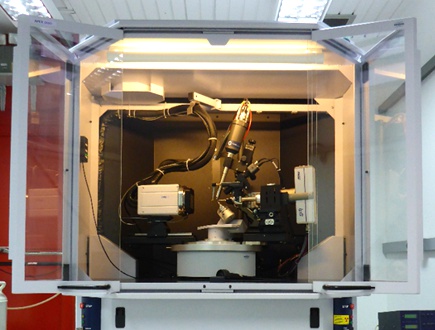
Apex II DUO (BRUKER) – Single Crystal X-ray Diffractometer
BRUKER Apex II DUO is a Kappa four circles geometry diffractometer (D8 model) equipped with an APEX II CCD area detector, a Mo (fine focus sealed tube, λ = 0.71Å) X-ray source and an Oxford Cryostream-700 low-temperature device that allows data collections at temperatures between 80 – 400 K, with most single-crystal samples being collected at 120 K. Data collections performed at BRUKER Apex II DUO diffractometer are essentially performed for structure determination of small molecules, including organic and inorganic compounds, metallic complexes and salts, exclusively when these specimen are produced as suitable single crystals. The determination of absolute configuration of chiral compounds from anomalous scattering is possible in some cases. The laboratory also counts on a SZ-61 (OLYMPUS) microscope with polarized light for selecting, manipulating and mounting of samples’ crystals.
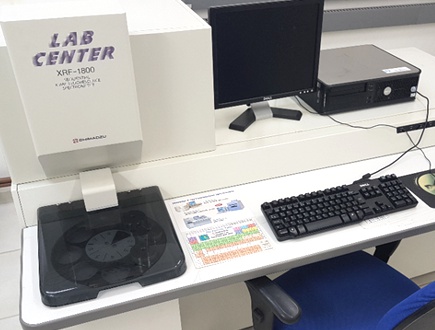
XRF-1800 (SHIMADZU) – Sequential X-ray Fluorescence Spectrometer
XRF-1800 (SHIMADZU) is a wavelength dispersion fluorescence spectrometer designed for the detection and measurement of secondary X-rays of elements from fluorine onwards to give elemental concentrations in solid samples or powder samples pressed into pellets. One of its great advantage is the possibility of standardless analyses, as the software uses internal fundamental parameters to estimate the elemental composition of the samples.
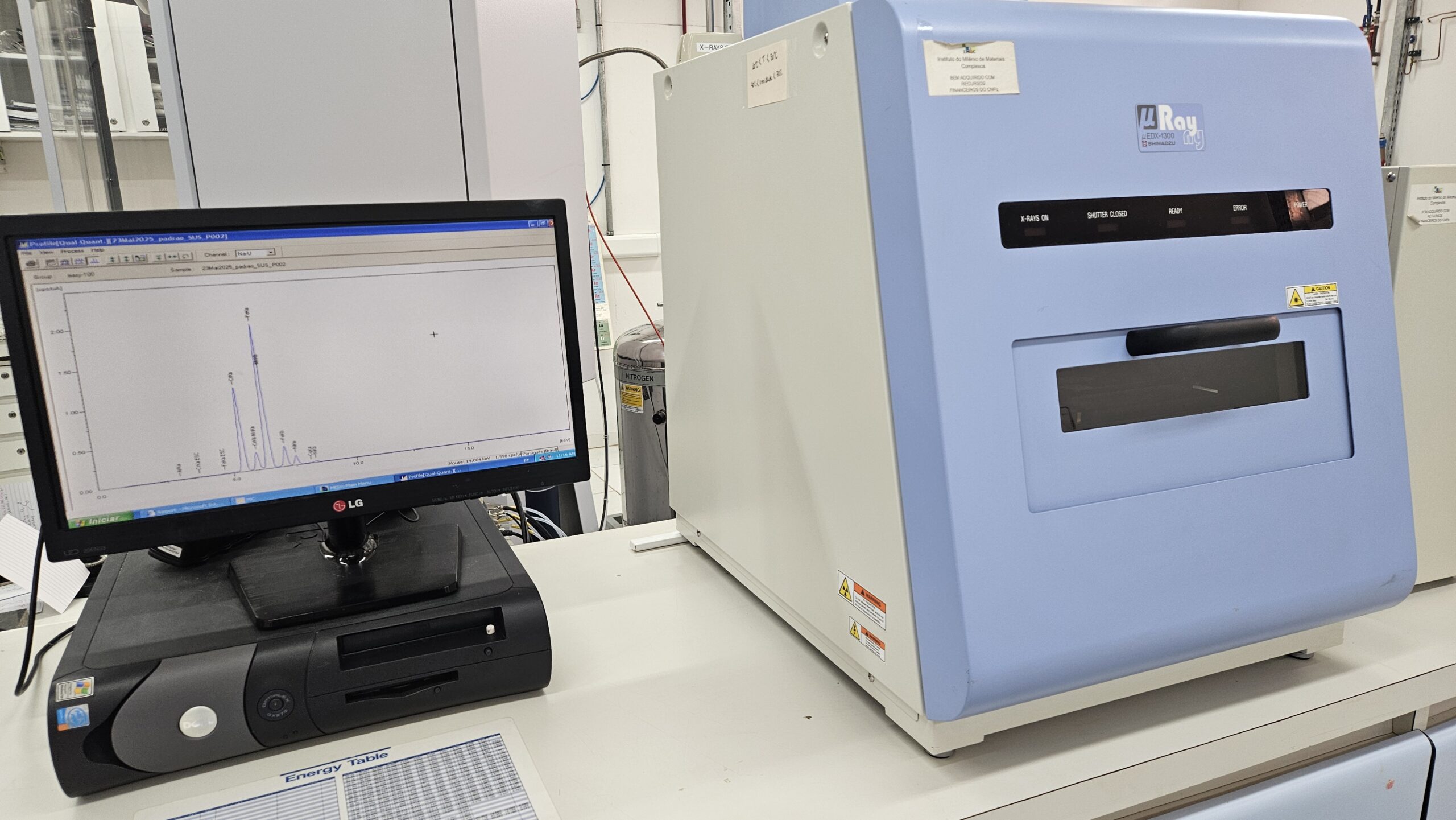
µEDX-1300 (SHIMADZU) – Energy Dispersive X-ray Fluorescence Spectrometer
µXRF-1300 (SHIMADZU) is an energy dispersion fluorescence spectrometer allows the detection and measurement of secondary X-rays of elements from magnesium onwards to give elemental concentrations in solid samples or powder samples. This equipment performs measurements in specific and selected areas of 50 micrometer (diameter) over the surface of the samples, offering the advantage of standardless analyses, as the software uses internal fundamental parameters to estimate the elemental composition of the samples.
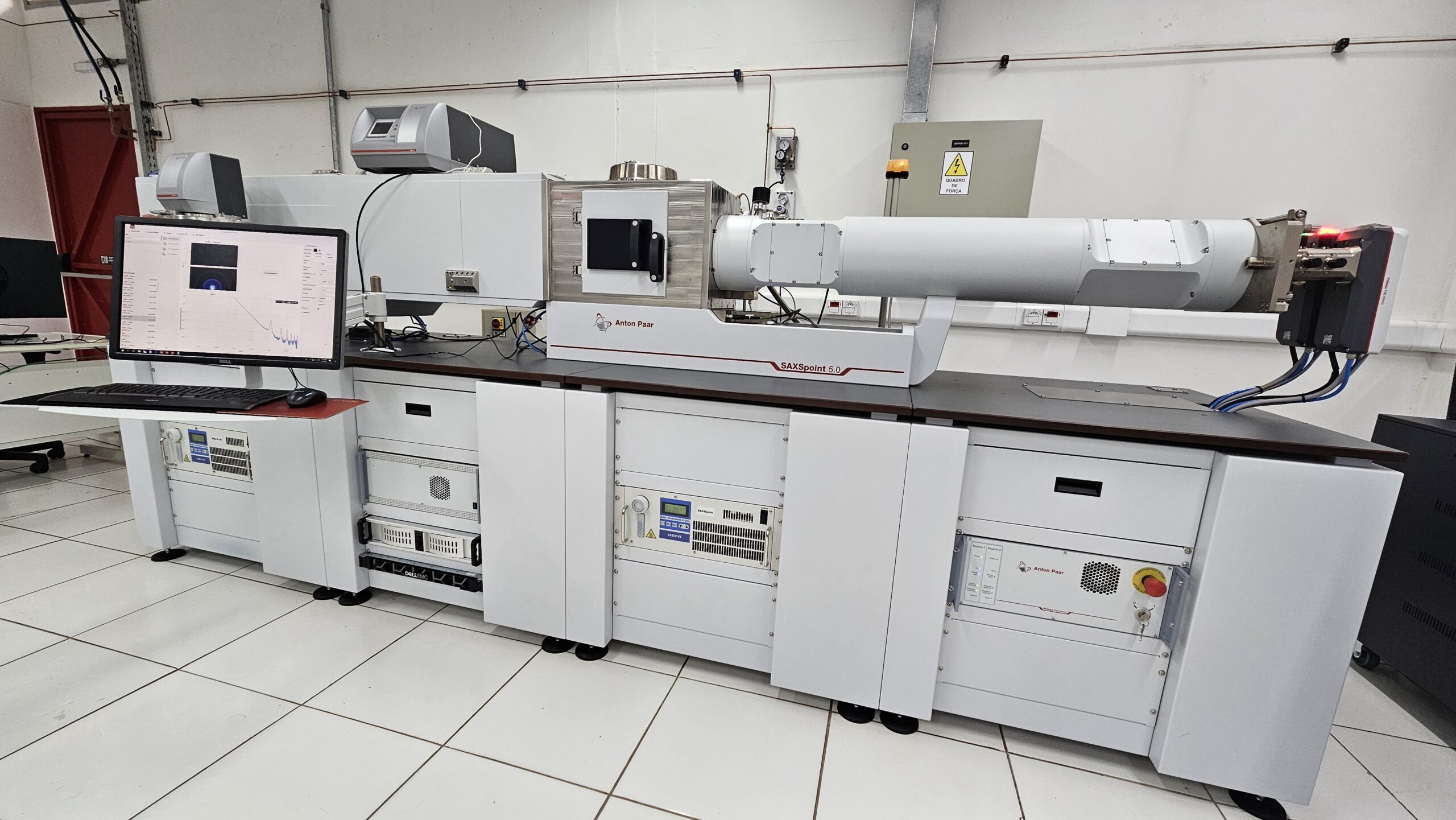
SAXSpoint 5.0 (Anton-Paar) – Small-angle X-ray scattering systems
The SAXSpoint 5.0 (Anton-Paar) is a system for small-angle X-ray scattering (SAXS) measurements used to analyze material nanostructures in the range of ~1 to 200 nm, within a q-range (scattering vector) from 0.01 to 47.5 nm⁻¹. Equipped with two radiation sources (Primux 100 Cu and Mo micro-sources) and a 2D HPC Eiger2 detector, the system includes a high-resolution WAXS module, enabling data collection from 1 to 50° (2θ).
The instrument features different types of sample holders, allowing experiments with liquid, powder, film, paste, suspension, and gel samples. The capillary measurement system is equipped with a temperature controller, enabling data acquisition from 5 °C to 90 °C.
Team