
Simplifying Synthesis with Radical Cross-Coupling
Palestrante: Prof. Phil S. Baran – The Scripps Research Institute – Califórnia – Estados Unidos
Abstract: Polar disconnections are intuitive and underlie much of retrosynthetic logic. Undergraduates exposed to multistep synthesis are often taught to assemble organic molecules through the combination of positively and negatively charged synthons because, after all, opposites attract. In- deed, the most employed two-electron C–C bond forming reactions today are those either based upon classical cross- coupling reactions (e.g., Suzuki, Negishi, Heck) or polar ad- ditions (aldol, Michael, Grignard). These reactions are the mainstay of modern synthesis and have revolutionized the way molecules are constructed due to their robust and pre- dictable nature. In contrast, radical chemistry is sparsely covered beyond the basic principles of radical chain pro- cesses (i.e., radical halogenation). The historical perception of radicals as somewhat uncontrollable species does not help the situation. As a result, synthetic chemists are not prone to make radical-based strategic bond disconnections during first-pass retrosynthetic analyses. In this talk recent studies from our lab will be discussed to illustrate the strategic advantages that can result when unconventional radical disconnections are incorporated into synthetic design plans.
Short CV: Through his research, Phil Baran, PhD, explores Organic synthesis, one of the great branches of Chemistry that has had a profound impact on the betterment and advancement of civilization. In its most modern manifestations, it renders the dream of alchemy (turning something worthless into something valuable) a reality. It places the practitioner into the role of artist, engineer, and astronaut. Baran’s research finds new ways to circumvent the bottlenecks of sustainable, scalable synthesis that allow organic molecules to be more rapidly transformed into viable therapies. The chemical products developed in his lab have shown major utility in a multitude of disease areas and his methods are widely used in pharmaceutical, agrochemical, and materials science sectors. Baran received a BS from New York University and a PhD from Scripps Research. He was a postdoctoral fellow at Harvard University before returning to Scripps Research as a faculty member. The mission of his laboratory is to simplify the practice of synthesis and, in doing so, educate students and postdoctoral scholars at the intersection of fundamental organic chemistry and translational science. Baran has educated hundreds of scientists over the years, co-founded numerous companies (Sirenas, Vividion, Elsie, and several others in stealth) based on his lab’s research and is the recipient of a notable list of awards and honors that recognize the impact of his research. These include the Danisco Foundation Science Excellence Award, the Manchot Research Professorship Award, the Emanuel Merck Lectureship, the ACS Elias J. Corey Award, the Blavatnik National Laureate in Chemistry Award and a MacArthur Fellowship. Baran is also an elected member of the National Academy of Sciences, the American Academy of Arts and Sciences and a Fellow of the Royal Society of Chemistry.

Últimas novidades
-
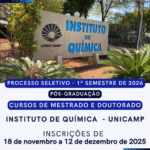 Processo Seletivo para o 1º semestre de 2026 – Pós IQ/UNICAMP18 de novembro de 2025
 -
 Comenda do Mérito Químico 202518 de dezembro de 2025
 -
 Prêmio PAEPE 20254 de dezembro de 2025